Only 2 chose to leave in a decade
- Contribution
- VP of Product Design & Research
- Team
- 22 designers and researchers
- Timeframe
- 2016–2026
- Outcome
- Built Product Design and Research from a team of one into a global organization of 22. Over ten years, two people left voluntarily. One left Design to become a sales development representative; the other returned to branding and marketing.
The company's only designer told me she was leaving
On my first day at Workato, the company's only designer told me she was leaving.
I had joined part-time. Workato was pre-seed and had less than $1 million in revenue. Suddenly, I was responsible for the entire product experience of an enterprise automation platform. The company had no research function, career structure, staffing model, or shared view of what Design could contribute. By 2021, Workato's last publicly announced valuation had reached $5.7 billion.
Over the next decade, I grew Product Design and Research into a global organization of 22. The team helped the platform evolve through three eras: integration workflows, copilots, and agents that can act on a user's behalf.
Across that decade, only two people voluntarily chose to leave. One left the design profession to become a sales development representative. The other returned to branding and marketing. These figures cover the entire Product Design and Research organization, which operated as one team with no internal transfers to another design group.
I can't claim to know every reason people stayed. Remote flexibility mattered. So did the people they worked with, the product knowledge they accumulated, and their individual circumstances. Other departures resulted from performance decisions or role eliminations.
What I do know is the kind of organization I deliberately built: one where people could exercise judgment, deepen their craft, take on meaningful responsibility, and grow along a path they chose. I did that by distributing conviction and care across the team until quality became a shared responsibility.
Give every decision an owner
When I was the only designer, consistency depended on my attention. Growth required a different model.
I wanted designers to own the reasoning behind their decisions: understand the customer's work, technical constraints, business consequences, and effects on the wider product; explain why they believed in a direction; listen seriously to competing views; and change their minds when the evidence was stronger.
Research supports the same principle. It helps the company understand problems and challenge assumptions before decisions become expensive to reverse.
Research was the first new function I advocated adding to the design organization. I began building that capability through interns. In December 2019, I hired Wayne Wu as Workato's first full-time researcher. Research has since become its own discipline and contributes to product strategy across the company.
Hire for what people can become
My first full-time design hire was Nikhil Venkatesh in 2018.
He joined as a UX Designer, became the first designer for Workato's API platform, and established the design foundations of its embedded platform. His background in animation raised the quality of interaction and motion across the product. He used his coding skills and working prototypes to explore increasingly technical ideas.
As his capability expanded, so did the problems he owned.
Today, Nikhil is Director of Product Design. He leads core platform design, design systems, visual design, and a substantial part of the product-design organization. More recently, he led our transition into AI-assisted design and prototyping.
For years, he considered both individual-contributor and management paths. My job was to give him meaningful room to try each before he chose management.
His progression taught me what scaling required: more people with the context, judgment, and authority to make consequential decisions.
Build an architecture for growth
I initially hired generalists because the product needed help everywhere. As the team grew, I became more deliberate about the skills, experiences, and perspectives I added.
I built a central organization spanning the United States, Canada, Europe, and Singapore. Designers develop expertise in particular areas while remaining connected to the wider discipline. I made it possible for people to move between projects so product knowledge and design principles could travel with them.
That movement matters. In late 2025, Xiuying Zhang began designing the interaction system for Canvas, a visual workspace in the product. When she went on planned leave before an important customer presentation, Taylor LeCroy moved over from Agent Studio and continued the exploration. When Xiuying returned, Taylor handed back both the work and the reasoning behind it. Xiuying combined the two rounds of thinking into the system she continued to develop.
I also learned that specialization could weaken ownership. In 2021, I introduced Content Design as a separate discipline. The boundary between Content and Product Design created friction over who owned the final experience, so I later folded product copy back into the designer's role. AI now helps the team standardize and critique content while designers retain responsibility for the final experience.
As the organization expanded, informal expectations became unreliable. People needed to know how they could grow, and strong individual contributors needed a credible long-term path.
In 2023, I initiated the development of a career framework. HR supplied the company-wide job architecture. I asked discipline leaders and the wider team to define and challenge progression within Product Design, Product Research, and Digital/UI Design. Wayne developed the Product Research track. Nikhil led much of the Product Design track, with detailed feedback from Alex. The result contains six individual-contributor levels and five management levels, assessed across four dimensions:
- Craft and technical capability
- Scope and consequence of results
- Self-direction and learning agility
- Communication, collaboration, and people leadership
Progression moves from completing defined work to operating independently, resolving unfamiliar problems, teaching others, influencing work beyond one's area, and shaping strategy. Management and individual-contributor leadership are parallel paths with different responsibilities.
Senior designers could mentor junior colleagues to experience part of what management involved. Iliana Ishak enjoyed it and moved into management. Serene Chen and Guanyi Fu learned that their interests lay elsewhere.
The framework now informs development planning, performance conversations, promotion nominations, and talent calibration. It has completed only one full cycle, so its long-term effect is still emerging. Its immediate value is simpler: employees and managers now share a clearer definition of greater scope.
Keep growth a real choice
Serene had been clear that she wanted to work on AI. When Workato formed a team around Workato Go, a standalone conversational product, I placed her there to lead its design. A year later, the company shifted its investment away from the product.
Her next assignment exposed a tradeoff. Nikhil's platform organization urgently needed an experienced designer, while Iliana's AI organization appeared better staffed. The platform team was the obvious operational choice; the AI team matched Serene's stated direction.
I asked her to speak with both leaders and choose. She chose the AI team. I honored that decision and opened roles to fill the platform gap.
Her choice made staffing less convenient and development more meaningful.
Stop being the quality gate
Earlier in my tenure, virtually everything passed through my review. Today, important features ship under the guidance of other leaders.
I still join critiques, watch every user interview, often at twice the normal speed, and stay close to work where my involvement can materially improve the outcome. Managers and senior individual contributors now guide most of the product.
The clearest evidence that the principles I established have traveled is how designers reason when I am absent.
Zubaida Al Zubaidi joined Workato directly from college in 2023. She now works on Advanced Mapper 2.0, which helps customers transform and connect complex data inside automated workflows.
When inline schema editing threatened to clutter the mapping canvas, she argued for a separate experience. When Engineering objected to stacking several transformations inside one node, she defended the approach: representing every operation as another node would make complex transformations harder to understand.
She also changed her position when the reasoning supported it. Engineering showed that a confirmation dialog added little value to an action that could be reversed immediately, so she removed it. When a proposed connection violated an agreed rule for incompatible data types, she accepted the correction.
Protect conviction when pressure rises
Asking designers to own their decisions creates a corresponding duty for their leaders.
Decision Models, a product for representing business rules, tested that duty. The design team first proposed a structured interaction similar to Workato's workflow editor. Engineering raised legitimate concerns about cost and complexity. The work took longer than expected, and Design began to be described as delaying the release. The team eventually chose a freeform canvas.
Usability research identified fundamental problems in the product scheduled for general availability. Even experienced technical builders faced a steep learning curve. Before reaching the table where they expected to begin, they had to define inputs, internal fields, and outcomes across disconnected panels. Some needed help to complete the sequence, confused outcomes with outputs, and struggled with terms such as “model fields,” “first matching,” and “every matching,” which described the architecture more clearly than the user's task.
After the research readout, I asked the team to treat that confusion as a blocker and escalated the findings to product leadership.
The release proceeded on schedule. Within a few weeks, we shipped the clarity improvements Research had identified.
Turn the quality bar into a business advantage
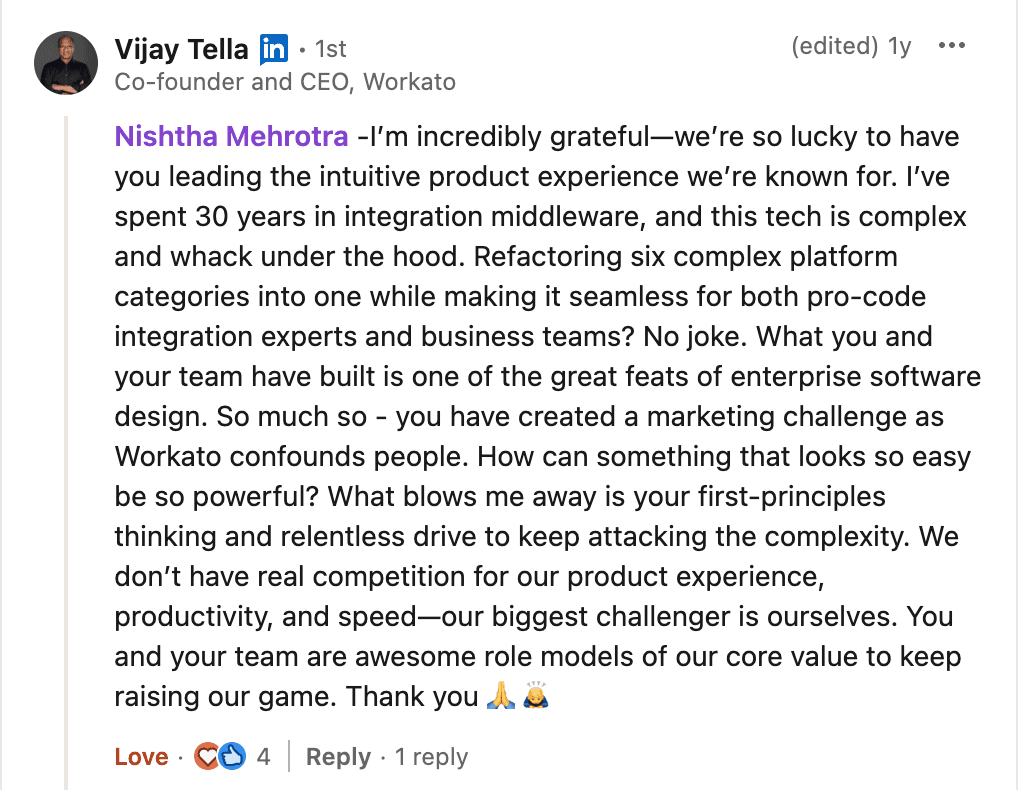
Workato's product experience is a cross-functional achievement, shaped by Design, Product Management, Engineering, Customer Success, and others.
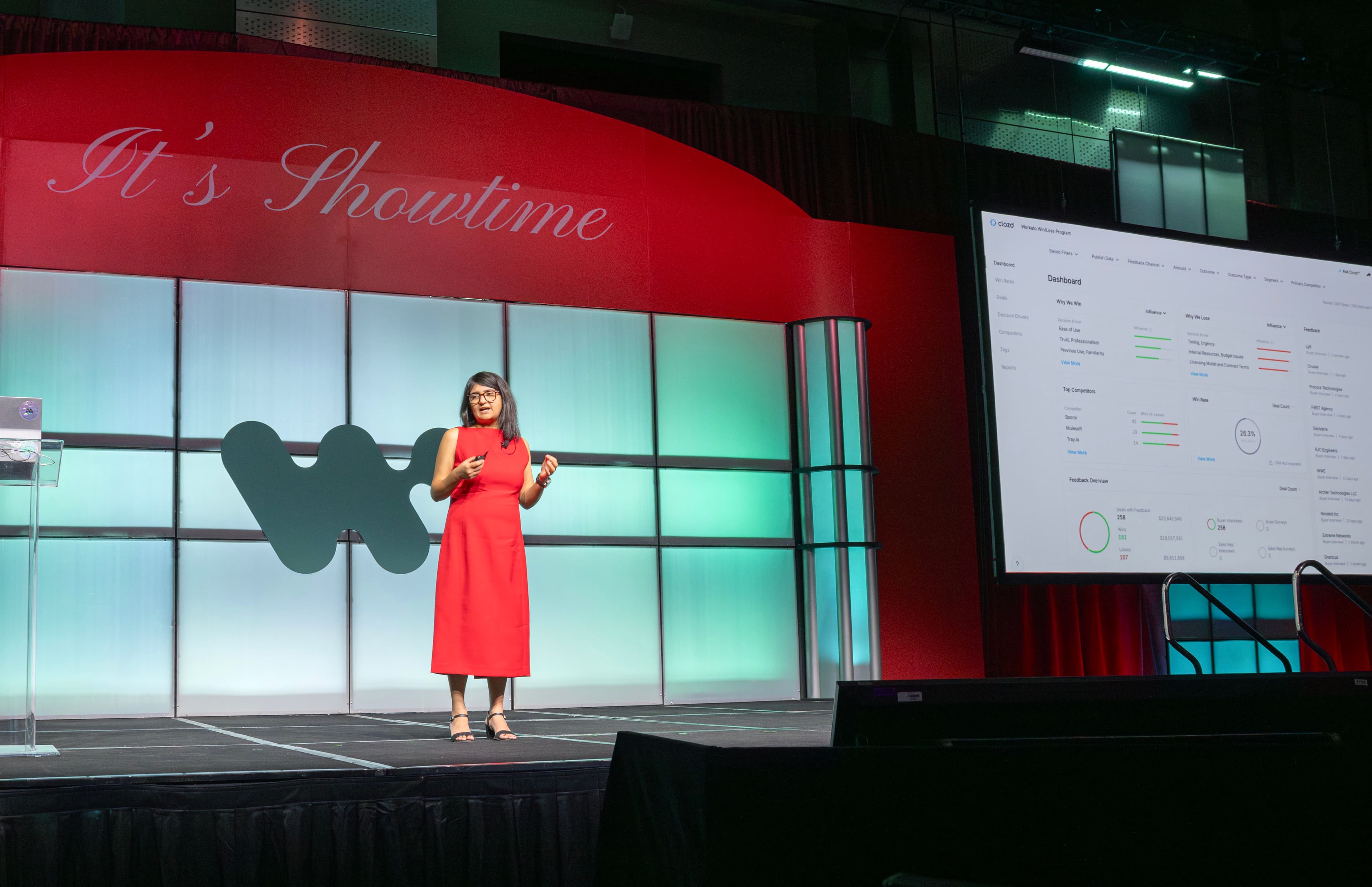
Over time, that experience became measurable. The latest data from Workato's Clozd win-loss program covers 1,827 deals, including 258 deals with feedback from 258 buyer interviews. Ease of use was the single most influential reason Workato won, ranking ahead of trust and professionalism and buyers' previous use or familiarity. Across all outcomes, ease of use received 83 ratings with an average influence score of 1.22.
Prepare the organization for its next test
AI is changing who can make software tangible. Designers can now explore ideas through working prototypes and encounter technical constraints much earlier. That extends the standard I had already established: know why you believe in a direction, make the reasoning visible, and remain open to better evidence.
I asked Nikhil to lead the organization's response. He built Fluid-ai, a registry that connects Workato's production components, Figma library, design tokens, interaction guidance, and copy rules. He also created Design Sandbox, where designers can build prototypes using the same components as the product.
Early internal measurements showed a substantial change:
| Task | Before | With AI |
|---|---|---|
| Build an on-brand interactive prototype | About 3–5 days | About half a day |
| Re-create a screen for exploration | About half a day | About 5–10 minutes |
| Produce a coded prototype | Usually required Engineering | Possible within minutes |
These early operational observations show that designers gained another material in which to think and another way to make an argument tangible. More rigorous benchmarking would be needed to establish the size of the improvement.
Adoption grew when people saw colleagues apply AI to familiar work. At our 2026 offsite, I organized a session called "Good artists copy; great artists steal." People demonstrated applications they had developed:
- Serene turned Figma work into coded prototypes using Workato components.
- Hoai Nguyen created a critique skill based on our standards and historical feedback.
- Alex reduced a live-product QA exercise from roughly a day to about an hour.
- Sabrina Quek used Claude to support a behavioral segmentation of 14,433 paid workspaces, an analysis that previously required substantially more specialist support.
The session made learning practical and social. People could see a technique applied to recognizable work, adapt it to their own problems, and share what they learned. Team members extended Nikhil's initiative into critique, research, QA, competitive analysis, and knowledge management. I supported his leadership, created opportunities for peer learning, and stayed close enough to understand what the transition required.
The career framework I initiated predates this transition, and AI fluency remains outside its current criteria. I chose to build capability before making it an expectation. I am giving people access, infrastructure, examples, and opportunities to practice, then observing which behaviors improve design outcomes and which reflect familiarity with a particular tool.
Adding criteria too early would reward unequal starting conditions and encourage performative adoption.
People stayed while helping the organization change
I can't reduce a decade of individual choices to one management system.
I know that flexibility mattered. People could develop specialties, move between product areas, try management before committing to it, or decline management and continue to grow. A central team allowed knowledge to travel. The career framework made advancement clearer. Managers and senior individual contributors created new centers of leadership. Long tenure preserved context, while new products and technologies kept the organization learning.
AI is testing that system again. Adoption remains uneven, the infrastructure is still developing, and I will update the career framework when the new expectations can be defined fairly.