Can streamed AI responses have conversational etiquette?
- Role
- Co-inventor
- Team
- Nikhil Venkatesh
- Timeframe
- 2023
- Outcome
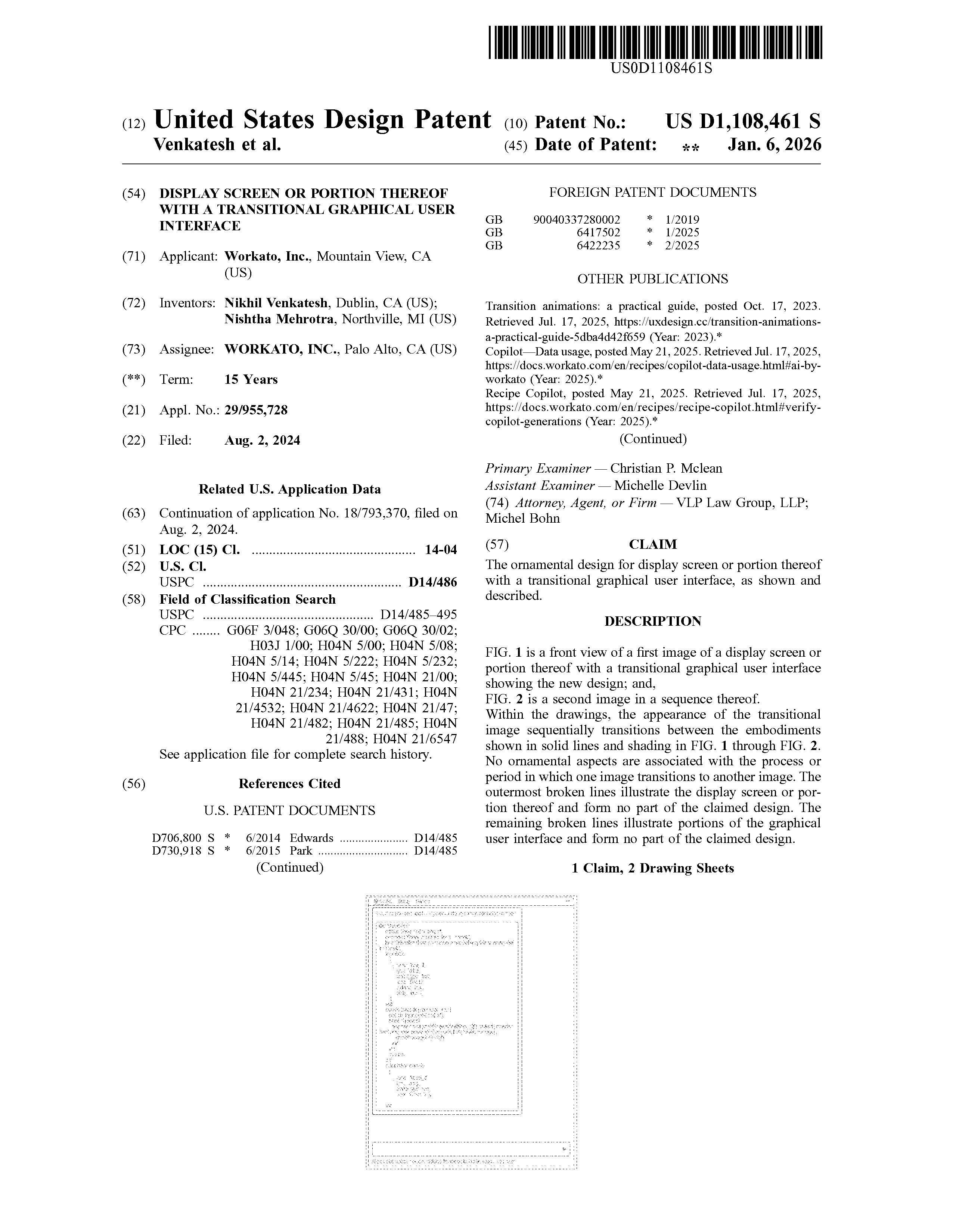
- Design patent granted (US D1,108,461 S)
Streaming has no turn-taking cues
We launched Workato Copilot in 2023. It generated structured responses inside our recipe and connector builders, often combining instructions, outlines, and blocks of code.
These responses arrived as a stream, so the chat bubble kept changing shape as the model produced more text. The interface felt unstable and jittery. When generation paused, the bubble also appeared complete, even when more content was still coming.
In human conversation, tone, pauses, and body language tell us whether someone has finished speaking. We wanted to bring those same cues into the chat interface.
The interaction needed to satisfy three conditions:
- Make it clear that the response is still forming.
- Make completion noticeable without demanding attention.
- Make the transition feel conversational, not like system status.
The proposal
While a response is streaming, its left edge is defined while its right edge fades into the background. The bubble looks unfinished because it is unfinished.
When generation ends, the border resolves around the complete message. After a brief pause, color fills the bubble and the input becomes active again. Together, these cues signal that the model has finished speaking and it is the user's turn to respond.
Before and after
Top: Before. Bottom: After. The same conversation, with the same delay in streaming. Above, a conventional bubble appears finished whenever the stream pauses. Below, the unfinished edge makes it clear that the response is still being written.
Why this detail mattered
It was a small change, but it improved the rhythm of the interaction. People could tell whether Copilot was still working without reading a status label or interpreting an indefinite spinner.
The pattern shipped in Workato Copilot's recipe and connector builders.
The underlying system was filed as a U.S. utility application (2025/0047627 A1), and the transition itself was granted as a U.S. design patent: Display Screen or Portion Thereof with a Transitional Graphical User Interface (US D1,108,461 S).